Childhood Reads Revisited
-
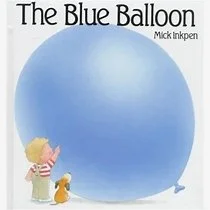
The Blue Balloon by Mick Inkpen
When I picked up Mick Inkpen’s picture book The Blue Balloon to re-read it for this review, I was struck by all the memories that came flooding back to me. From the moment I saw the big blue balloon on the cover with its unforgettable sheen, I remembered how much I loved looking at it as a kid and how much fun it gave me. Blue was, and still is, my favourite colour because of this book.
It’s hard to put into words how great the story and the images are in this book. The artwork is quite simple really, but it manages to invoke imagination within a child. There are only 3 elements in the book, the boy, his dog, and the magic balloon, but somehow it captures a sense of wonder and adventure. From when the dog finds the old soggy balloon, to the balloon bringing them to space and also getting them home in time for tea, there are so many playful images of what the balloon is capable of doing along the way. When the balloon disappears, I really enjoyed the way the artist drew lines around where it would have been. When you see it reappear on the next page as a square, it’s a relief! Some of the pages are fold-out which really adds to the magic.
I think that this book is wonderful, and although today we have so much technology and AI, I think that a modern child can find something in this book that tech or AI will never be able to replicate.
Hodder & Stoughton Children’s Books, 1989
ISBN 0 340 55884 9
Reviewed by Cormac Hennigan
-
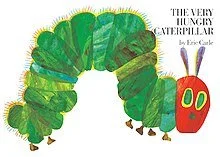
The Very Hungry Caterpillar by Eric Carle
This is a book that is very dear to me. It is one of my childhood books that I remember vividly. Something about the illustrations really taught me about colour and texture. The very first image of the caterpillar’s egg on the leaf invited me as a child to reach out and touch it. The beautiful image of the egg on a tree at night-time, with the face of the moon in the background is wonderfully haunting.
When the caterpillar starts eating the different fruits, they all vary in colour, but the artist manages to capture the essence of each of the different fruits and why they are the colour that they are. You also have to turn each of the fruits over to get to the text, which is a good exercise for a child, and it really makes each one of the fruits stand out.
When we get to the part where the caterpillar eats all sorts of human food for a feast, not only is this fun for a child because it is so absurd, but again the artist manages to capture the essence of each of the foods, and it makes me want to touch and eat that abstract version of the food! The ending of the story is beautiful, because the Caterpillar turns into a butterfly, and while the colours chosen here look abstract, they are also realistic because butterflies are so colourful.
I think that a child today would really enjoy this book because it is different to the modern crisp and clean images that they are used to.1969
ISBN
Reviewed by Cormac Hennigan